September 15, 2026
How to Choose the Right Stone Crusher Machine for Your Project
Learn how to choose the right stone crusher machine for your operation. We cover material hardness, output size, capacity, and job site factors to maximize efficiency.
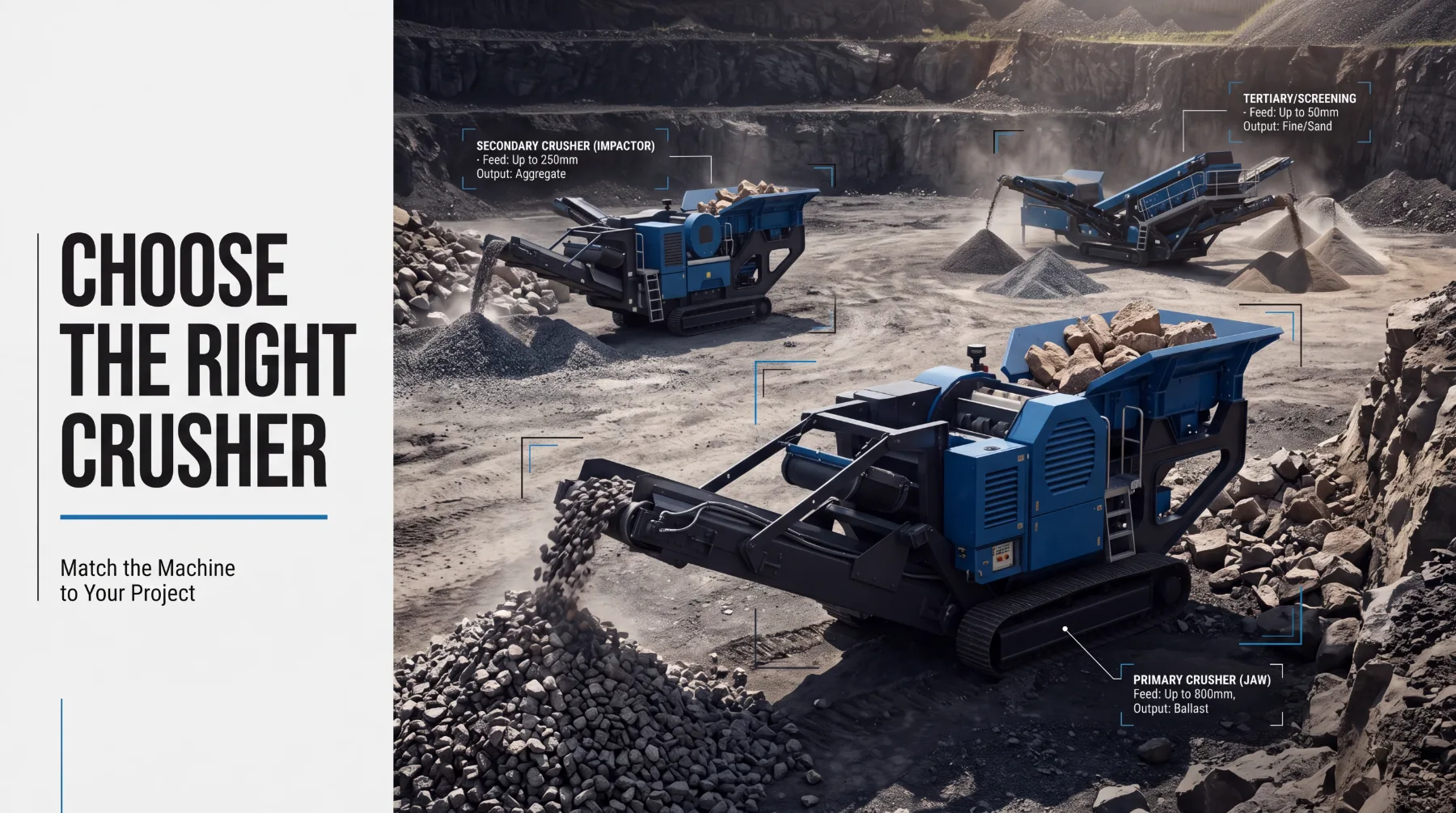
How to Choose the Right Stone Crusher for Your Project
Selecting a stone crusher is a decision that shapes the efficiency, cost, and quality of your entire operation. Choose well, and you get a machine that processes material at the pace your project demands, produces consistent aggregate, and runs dependably for years. Choose poorly, and you risk slow output, wasted fuel, unsuitable material, and frequent downtime. The right crusher is never a matter of picking the biggest or cheapest option; it is about matching the machine to your material, your output needs, your production volume, your jobsite, and your long-term operating realities. This guide walks through the five factors that matter most, giving you a clear framework to judge any crusher against the real demands of your work. By the end, you will know exactly how to make a confident, informed choice.
Understand the Material You Need to Crush
Everything about crusher selection begins with the material you plan to process, because the stone itself dictates what kind of machine and crushing method will work. Four characteristics deserve close attention: the type of material, its hardness, its size, and its moisture content. Getting a clear picture of each before you shortlist any machine is the surest way to avoid a costly mismatch, since a crusher that suits one material can struggle badly with another. Material type and hardness are the starting point. Hard, abrasive rock such as granite or basalt places heavy demands on a machine and calls for a robust crushing action built to break tough stone while resisting wear. Softer or more brittle materials break more easily and may suit a different mechanism that produces a cleaner, more shaped result. Matching the crusher to the hardness of your material protects both output quality and the longevity of the machine, because forcing a crusher to work against material it was not designed for accelerates wear and drives up costs. The size and moisture content of your feed material matter just as much, and they are easy to overlook. Consider how these two factors influence your choice: Feed size: the largest pieces you intend to process must fit within the machine's feed opening, so a crusher has to be sized to accept your raw material without jamming or requiring pre-breaking. Moisture content: wet, sticky material can clog certain crushers and reduce throughput, so damp or high-moisture feed may call for a machine and configuration suited to handling it cleanly. Taking the time to assess type, hardness, size, and moisture together gives you an accurate profile of what the machine must handle. That profile becomes the foundation for every other decision, ensuring the crusher you choose can process your specific material efficiently rather than fighting against it day after day.
Determine the Required Output Size
Once you understand your feed material, the next decision is what you need to produce, because the finished aggregate size plays a major role in which crusher fits your project. Construction and landscaping work rarely calls for a single generic product. A road sub-base needs coarse graded aggregate, concrete demands specific stone fractions, drainage systems require clean gravel, and decorative landscaping often calls for finer, more uniform material. Defining the exact output size you need is therefore essential before you compare machines, since a crusher must be capable of consistently producing that finished size to be genuinely useful to you.
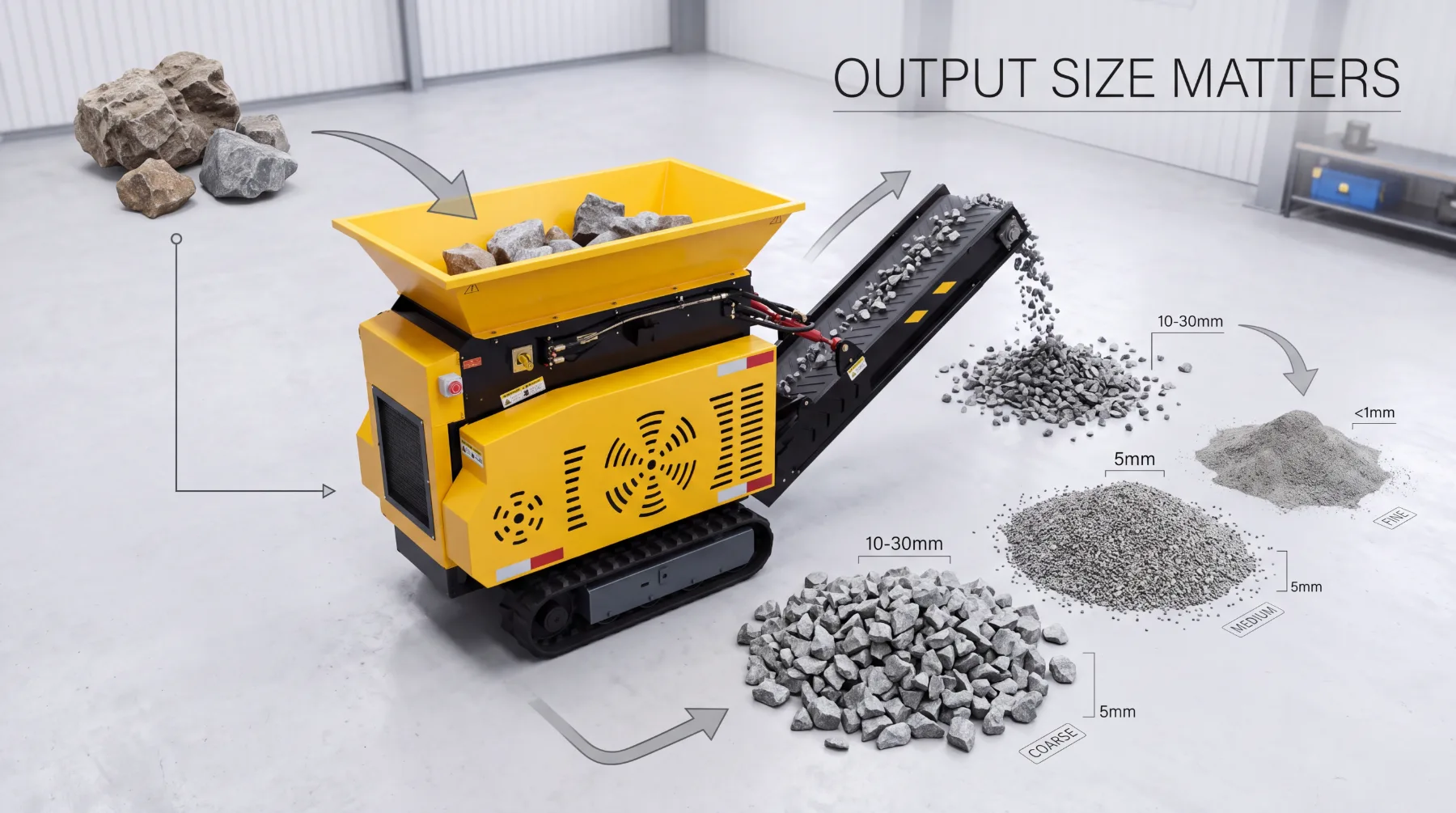
Consistency is the key word here. It is not enough for a machine to reach a target size occasionally; it must produce that size reliably, load after load, so your material meets specification every time. Construction projects in particular depend on aggregate that conforms to exact requirements, and inconsistent output can compromise the quality of concrete, road base, or drainage work. A crusher that delivers uniform, predictable sizing protects the integrity of everything you build with the material it produces, which is why output consistency should weigh heavily in your decision. The output size you need also guides how many stages of crushing your project requires. Some finished products come from a single pass through a primary crusher, while finer or more precisely sized material may need a second stage to reduce and shape it further. If your project demands a fine, consistent aggregate, a single coarse crusher may not reach that specification on its own, and you may need to plan for secondary crushing. Thinking carefully about your required output size, and how many stages it takes to reach it, ensures you select a machine or combination of machines capable of delivering exactly the material your construction or landscaping work depends on, rather than a product that falls short of what you actually need.
Consider Crushing Capacity
Capacity is where you match the machine to the scale of your work, and getting it right protects both productivity and cost. Crushing capacity refers to how much material a machine can process over a given period, usually measured in tons per hour. The goal is to compare a crusher's expected production capacity against the volume of material your project needs to process, then choose a machine whose throughput suits that demand. A crusher with capacity well matched to your workload keeps material flowing steadily without creating bottlenecks or sitting idle. Getting capacity wrong in either direction carries a real cost. A machine with too little capacity for your project becomes a bottleneck, unable to keep pace with demand and slowing the entire operation while material backs up waiting to be processed. This drags down productivity and can leave crews and downstream equipment waiting. An oversized machine creates a different problem: it may process material far faster than your project requires, but that surplus capacity typically comes with higher purchase, fuel, and operating costs than you actually need. Paying for and running more machine than the work demands is money spent without a productive return. The sensible approach is to size capacity to your genuine requirements with a reasonable margin, rather than to the extremes. Estimate the volume of material your project must process within its timeframe, then look for a crusher whose rated capacity comfortably meets that figure without vastly exceeding it. A suitable capacity helps maintain productivity while keeping operating costs in proportion to the work being done. This balance is what defines a well-chosen machine: it processes your material at the pace your schedule requires, keeps your operation moving efficiently, and does so without the unnecessary expense that comes from running a crusher far larger than your project justifies. Matching capacity to need is one of the clearest ways to protect both output and your budget over the life of the work.
Match the Crusher to the Jobsite
A crusher that performs well on paper still has to work within the physical realities of your site, so matching the machine to the jobsite is a decisive part of the choice. Several practical conditions shape which crusher fits, including the space available, the terrain, transportation requirements, and whether the machine needs to operate in a fixed or mobile setup. Assessing these honestly before you decide ensures the machine you select can actually be deployed and operated effectively where the work takes place, rather than proving impractical once it arrives. Space and terrain come first. A large, fixed crushing installation suits a permanent site such as a quarry with ample room and stable ground, where the machine can be set up and left in place to process high volumes. A more confined or irregular site, or one where the crusher must work close to other operations, calls for a machine that fits the available footprint and handles the ground conditions present. Transportation is closely tied to this, because getting the machine to and around the site matters: a heavy fixed plant requires significant effort to install and relocate, while a machine intended to move between locations must be practical to transport. The choice between a fixed and a mobile setup deserves particular thought. Consider what your work involves: Fixed setups suit long-term operations at a single location, processing large volumes where the machine rarely needs to move. Mobile setups suit projects that shift between sites or require crushing at multiple points, letting the machine travel to where the material is. Compact equipment can be especially valuable when working in restricted areas. On sites where space is limited, access is tight, or the crusher must operate near other activity, a compact machine can move into position and work where a larger installation simply could not fit. Weighing space, terrain, transportation, and setup type together, with compact options in mind for confined conditions, helps you choose a crusher genuinely suited to the place it will work.
Evaluate Operating and Maintenance Needs
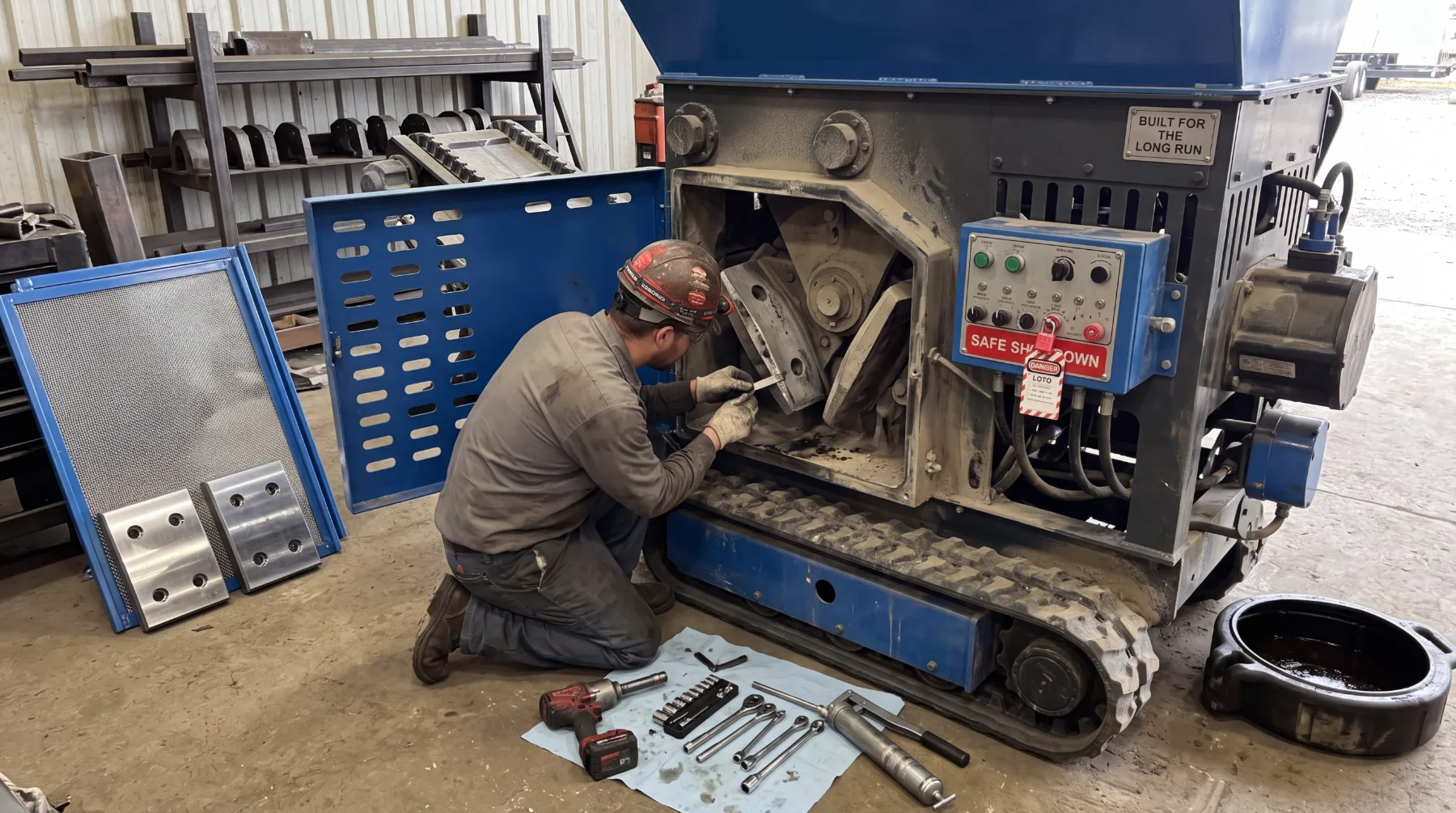
The final factor looks beyond initial performance to the practical realities of running and maintaining the machine over time, because these determine how efficient and dependable your crushing operation will be in the long term. A crusher that crushes well but is costly to run, difficult to maintain, or prone to downtime undermines its own value. Before committing to any machine, it pays to weigh its fuel or power requirements, ease of operation, maintenance access, durability, and the availability of replacement parts, since each of these shapes the true cost and reliability of ownership. Fuel or power requirements and ease of operation are practical starting points. The energy a machine consumes directly affects your operating costs, so a crusher whose power demands suit your available supply and your budget helps keep the operation economical. Ease of operation matters too, because a machine that is straightforward to run allows operators to work efficiently and reduces the risk of errors, keeping the crushing process smooth and productive throughout the working day. Maintenance and durability are where long-term dependability is won or lost. Consider these factors carefully before you decide: Maintenance access: a machine designed for easy access to wear parts and service points makes routine upkeep faster and less disruptive, reducing the downtime that maintenance would otherwise cost. Durability: a robustly built crusher withstands the demands of continuous work and resists premature wear, protecting your investment and keeping the machine productive over its full service life. Replacement parts: ready availability of the parts the machine needs means repairs can be completed promptly rather than leaving the crusher idle while parts are sourced. Considering these operating and maintenance needs together helps you choose a practical machine rather than one that looks capable at first but proves burdensome to run. A crusher that is economical to power, easy to operate, simple to maintain, durably built, and well supported with parts will keep your crushing operation efficient and reliable for the long term. That practicality, weighed alongside performance, is what separates a genuinely sound investment from one that costs you in hidden ways well after the purchase. Conclusion Choosing the right stone crusher comes down to weighing five factors together rather than any one in isolation. Start by understanding your material, since its type, hardness, size, and moisture content determine the crushing method and machine capabilities you need. Define your required output size next, because consistent, specification-ready aggregate is what makes the machine useful for your construction or landscaping work. Match crushing capacity to your project volume so you maintain productivity without paying for more machines than the job demands. Consider the jobsite carefully, accounting for space, terrain, transportation, and whether a fixed, mobile, or compact setup best suits your conditions. Finally, evaluate the operating and maintenance needs, from fuel and power to ease of operation, maintenance access, durability, and parts availability, to ensure the machine stays efficient over the long term. Weigh these five factors against the real demands of your work, and you will select a crusher that processes your material dependably, produces the aggregate you need, and delivers reliable value for years to come.
Frequently Asked Questions
1. Why does the material I plan to crush matter so much when choosing a crusher? The material determines nearly every other decision, because the stone itself dictates which machine and crushing method will work. Four characteristics deserve attention: type, hardness, size, and moisture content. Hard, abrasive rock such as granite or basalt demands a robust crushing action built to break tough stone while resisting wear, whereas softer or brittle materials break more easily and may suit a different mechanism that produces a cleaner result. Feed size matters because the largest pieces you process must fit within the machine's feed opening, or you risk jamming and the need for pre-breaking. Moisture content is easy to overlook but important, since wet, sticky material can clog certain crushers and reduce throughput. Assessing all four together gives you an accurate profile of what the machine must handle, which becomes the foundation for choosing a crusher that processes your specific material efficiently rather than fighting against it. 2. How does the required output size affect crusher selection? The finished aggregate size plays a major role, because construction and landscaping work rarely calls for a single generic product. A road sub-base needs coarse graded aggregate, concrete demands specific stone fractions, drainage systems require clean gravel, and decorative landscaping often calls for finer, more uniform material. You must define the exact output size you need before comparing machines, since a crusher has to consistently produce that finished size to be useful. Consistency is essential, as construction projects depend on aggregate that meets exact specification, and inconsistent output can compromise concrete, road base, or drainage work. The output size you need also guides how many crushing stages your project requires. Some products come from a single pass through a primary crusher, while finer or more precisely sized material may need a second stage to reduce and shape it further, so plan accordingly. 3. What happens if I choose a crusher with the wrong capacity? Getting capacity wrong carries a real cost in either direction. A machine with too little capacity for your project becomes a bottleneck, unable to keep pace with demand and slowing the entire operation while material backs up waiting to be processed. This drags down productivity and can leave crews and downstream equipment idle. An oversized machine creates a different problem: it may process material far faster than your project requires, but that surplus capacity typically comes with higher purchase, fuel, and operating costs than you actually need, meaning you pay to buy and run more machine than the work justifies. The sensible approach is to estimate the volume of material your project must process within its timeframe, then choose a crusher whose rated capacity comfortably meets that figure with a reasonable margin, without vastly exceeding it. This keeps productivity high while holding operating costs in proportion to the work. 4. When should I choose a mobile or compact crusher over a fixed installation? The choice depends on your site conditions and how your work is organized. A fixed installation suits long-term operations at a single location, such as a quarry with ample room and stable ground, where the machine can be set up and left in place to process high volumes and rarely needs to move. A mobile setup suits projects that shift between sites or require crushing at multiple points, letting the machine travel to where the material is. Compact equipment is especially valuable when working in restricted areas, since on sites where space is limited, access is tight, or the crusher must operate near other activity, a compact machine can move into position and work where a larger installation could not fit. Weigh the available space, terrain, transportation requirements, and setup type together, keeping compact options in mind for confined conditions, to select a machine genuinely suited to where it will work. 5. What operating and maintenance factors should I consider before buying? Looking beyond initial performance to the realities of running and maintaining the machine is essential, because these determine long-term efficiency and dependability. Start with fuel or power requirements, since the energy a machine consumes directly affects operating costs, so choose a crusher whose demands suit your available supply and budget. Ease of operation matters because a machine that is straightforward to run lets operators work efficiently and reduces errors. Maintenance access is important, as a machine designed for easy access to wear parts and service points makes routine upkeep faster and cuts downtime. Durability protects your investment, since a robustly built crusher withstands continuous work and resists premature wear. Finally, ready availability of replacement parts means repairs can be completed promptly rather than leaving the machine idle. Considering these factors together helps you choose a practical machine that keeps your crushing operation efficient and reliable for the long term.